
You Won’t Believe What’s Hidden Beneath Cancun’s Hotel Zone
From the sky, Cancun’s Hotel Zone looks like perfection — a glittering strip of white-sand beaches, turquoise water, and endless luxury. It’s a postcard brought to life. Resorts line the coast in perfect symmetry, infinity pools blur into the ocean, and nightlife pulses until dawn.
But beneath the polished surface of this paradise lies something most visitors never see — a secret world that tells a completely different story about Cancun’s past, its people, and the land that came long before the first hotel was ever built.
Because below the bars, shopping malls, and party lights, Cancun hides a history that’s older, darker, and far more fascinating than anyone expects.

The Land Before the Hotels
Before the Hotel Zone became one of the most famous stretches of coastline in the world, it was nothing but mangroves, jungle, and quiet lagoons.
In the 1960s, this narrow sandbar known as Kaan Kun — “nest of snakes” in Mayan — was home to only a handful of fishermen and the occasional wandering heron. There were no roads, no bridges, no neon signs. The island was wild, humid, and almost untouched.
Then came the vision: a Mexican government project to transform the area into a world-class tourist destination. In just a few decades, Cancun grew from a forgotten peninsula to a global hotspot that now welcomes millions of visitors a year.
But while the skyline changed, the earth beneath it didn’t. The limestone foundation of the Yucatán Peninsula is like Swiss cheese — riddled with underwater caves, cenotes, and tunnels that connect everything.
And that’s where the real secrets of Cancun’s Hotel Zone begin.
The Hidden Rivers Beneath Your Feet
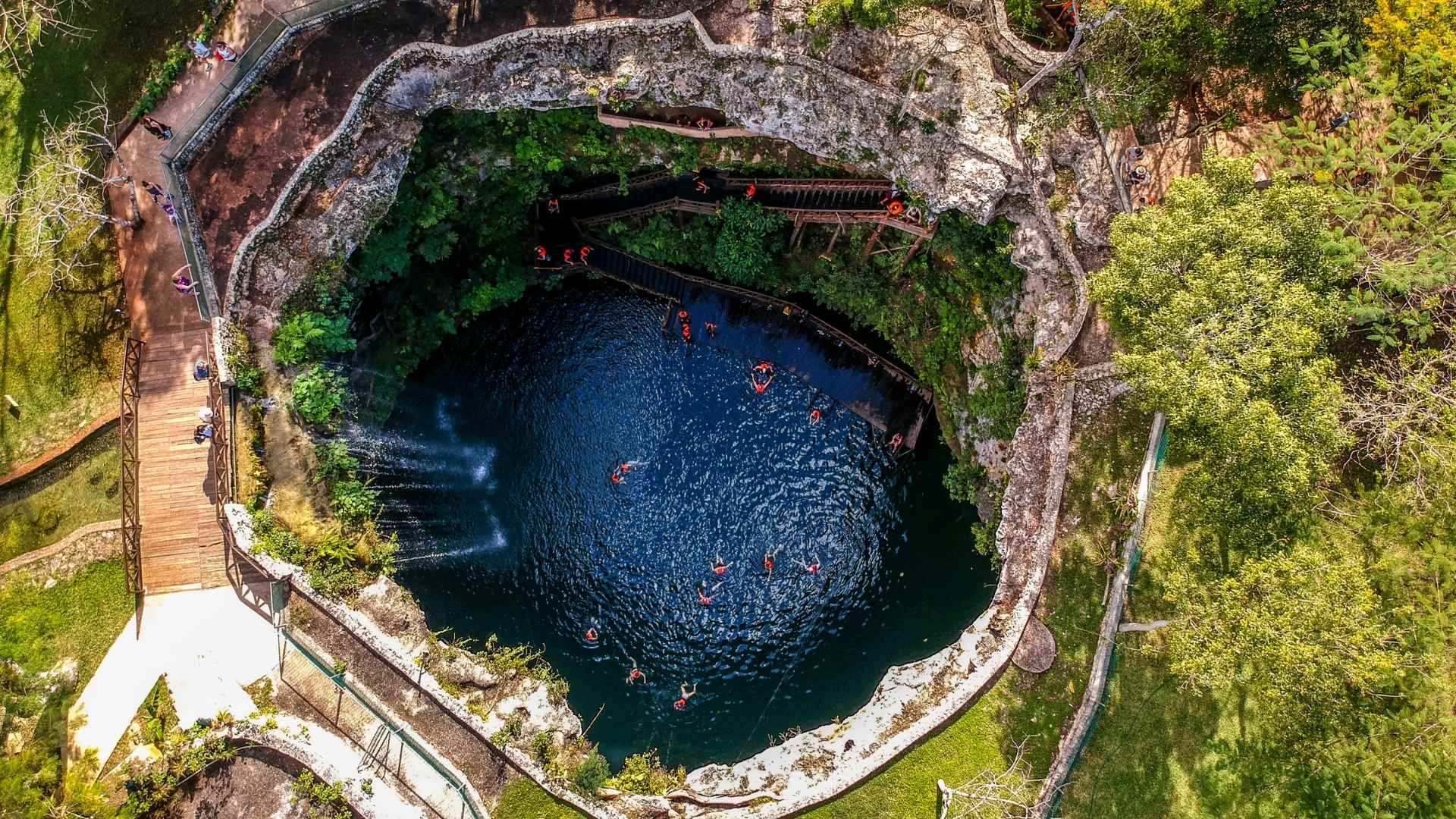
What most tourists don’t realize as they stroll between resorts or sip cocktails by the pool is that beneath them flows one of the largest networks of underground rivers in the world.
This labyrinth of flooded caves stretches for hundreds of miles beneath the Yucatán Peninsula — including right under the Hotel Zone. These are the same systems that feed the region’s famous cenotes, carrying crystal-clear water through limestone passages so intricate that divers have barely begun to map them all.
In some areas, these rivers run just a few meters below the foundations of luxury hotels. In others, they open into vast underwater chambers where stalactites hang like fangs from the ceiling.
Scientists studying the network have discovered ancient fossils, ceremonial artifacts, and even skeletal remains — remnants of a time when the Maya believed these waters were sacred gateways to the afterlife.
So the next time you’re floating in a rooftop pool, imagine this: just beneath the tiles and concrete, an ancient river is flowing — silent, cold, and eternal.
Mayan Mysteries in the Depths
The Maya never built directly on the sandbar that became Cancun’s Hotel Zone, but their influence is everywhere beneath it.
Archaeologists have uncovered small pre-Columbian structures hidden in the mangroves, their stone foundations half-swallowed by time. These ruins — often overlooked or fenced off near resort grounds — were once shrines and lookout posts guarding the trade routes that connected the ancient cities along the coast.
More intriguing are the artifacts found in the cenotes nearby: jade jewelry, pottery, and human bones carefully arranged as offerings.
The Maya believed these subterranean waters connected the world of the living with Xibalba, the underworld — a sacred place where spirits and gods met. To enter a cenote was to cross a threshold between realities.
And that’s what still lies beneath modern Cancun: an invisible bridge between the city’s glossy present and its mystical past.
The Ghost Infrastructure of Paradise
When Cancun’s rapid development began in the 1970s, engineers faced a challenge: how to build massive hotels on porous limestone without collapsing the fragile caves beneath.
The solution was complex — miles of hidden reinforcements, buried foundations, and drainage systems that weave through the natural tunnels below.
In some places, you can still find evidence of old construction shafts — concrete pipes leading into darkness, sealed decades ago. Locals who worked on the original projects tell stories of sudden sinkholes, strange drafts, and “bottomless” holes that swallowed entire machines overnight.
Today, maintenance crews occasionally stumble upon these forgotten spaces when inspecting resort utilities. They call them sombras del suelo — “shadows of the ground.”
Even in a city obsessed with sunlight, there are places where no one dares to look too closely.
The Cenote That Was Covered Up
One of the Hotel Zone’s most persistent legends involves a cenote said to exist beneath a major resort — a natural sinkhole that engineers supposedly discovered during construction in the early 1980s.
According to longtime residents, the cenote was small but deep — perfectly circular and filled with dark, still water. Workers claimed it made strange sounds at night, like whispers echoing through the tunnels.
Rather than reroute the building plans, the story goes, developers built over it.
No one knows which resort, exactly. Some say it’s one of the older ones near Punta Cancun; others insist it’s under a property closer to the Nichupté Lagoon. But every once in a while, guests report odd happenings — lights flickering, unexplained moisture in rooms, or a faint sound of dripping water late at night.
Coincidence? Maybe. Or maybe the cenote still breathes beneath the marble floors.
Life Beneath the Lagoon
If you’ve ever crossed one of the bridges connecting Cancun’s Hotel Zone to the mainland, you’ve seen the Nichupté Lagoon — that calm, glassy stretch of water on the western side of the island.
What few realize is that the lagoon itself is alive with hidden ecosystems. Beneath its murky surface are mangrove tunnels, coral remnants, and limestone shelves that once formed part of ancient seabeds.
Divers exploring the lagoon have discovered a surprising variety of marine life — seahorses, starfish, stingrays, and even small sharks. There are also underwater caves that link directly to the Caribbean, forming secret passages used by fish and, occasionally, by adventurous free divers.
But beyond the biology, the lagoon hides something else: the ghosts of Cancun’s first settlers.
Before tourism, fishermen built wooden shacks along its edge. Some remnants of those communities — rotted pilings, half-sunken boats, and rusted engines — still sit beneath the water, preserved by the salt and silence.
The Forgotten Bunker Theory
There’s another rumor whispered among locals who’ve worked in construction and maintenance: that somewhere beneath the Hotel Zone lies an abandoned bunker — a relic of the early 1980s when Cancun was considered a potential Cold War investment risk.
The story claims that engineers designed a small underground shelter as part of a contingency plan for government officials or investors. Over time, it was sealed and buried, its entrance paved over as new resorts expanded.
No proof exists, of course. But a few locals swear they’ve seen reinforced doors in service tunnels that lead to “nowhere.”
It’s impossible to say what’s real — but the idea of a hidden Cold War relic buried beneath a tropical paradise makes Cancun’s glossy surface feel even more surreal.
Nature Is Taking Back the Underground
Despite decades of development, nature is slowly reclaiming the underworld of Cancun.
Mangrove roots creep into drainage systems. Bats and iguanas nest in the shadows of forgotten tunnels. Fish swim through submerged construction sites.
Environmentalists now monitor the health of the underground rivers closely. Pollution from tourism has begun to seep into the freshwater network, threatening not just the ecosystem, but also the fragile balance that keeps the peninsula alive.
Ironically, the same forces that built Cancun’s success — its endless water, its limestone foundation, its connection to nature — are also what make it so vulnerable.
If the underground rivers are ever damaged beyond repair, the paradise above could crumble with them.
A Dual World: Above and Below
Every city has two sides — what it shows and what it hides. In Cancun, that division is literal. Above ground, you have the postcard: neon lights, luxury pools, and the rhythm of nightlife. Below, there’s silence, darkness, and history that refuses to disappear.
It’s a reminder that paradise isn’t always simple. For every perfect sunset photo, there’s an unseen story beneath the sand — one carved by time, by nature, and by the people who dared to build a city on top of an ancient sea.
And maybe that’s what gives Cancun its strange, magnetic energy. It’s a place that looks brand new, but is rooted in something far older — something that still whispers beneath the waves.
So What’s Really Hidden Beneath the Hotel Zone?
Everything.
Water that’s older than civilization. Caves that stretch into eternity. Legends of sacrifice, ambition, and survival.
Cancun isn’t just a destination — it’s a layered world, where modern luxury floats above ancient mystery. The tourists may come for the beaches, but it’s the stories beneath the surface that make this city truly unforgettable.
Because sometimes, the most beautiful places on Earth are built on secrets.
And in Cancun, those secrets are still flowing — just a few feet below your feet.


